
13th month pay computation: proration, salary changes, and unpaid leave
13th month pay is the total basic salary earned from January 1 to December 31 divided by 12. Salary increases, unpaid absences, and a mid-year hire date all affect the total, because the formula uses actual salary earned, not the current monthly rate multiplied by 12.
The formula
13th month pay = Total basic salary earned January to December ÷ 12
"Basic salary" means the regular monetary compensation before deductions. It excludes overtime pay, night differential, allowances, holiday premiums, and other earnings.
Effect of a mid-year salary increase
An employee earns ₱30,000/month from January to June. A salary increase to ₱35,000 takes effect in July.
| Period | Monthly basic salary | Months | Salary earned |
|---|---|---|---|
| January to June | ₱30,000 | 6 | ₱180,000 |
| July to December | ₱35,000 | 6 | ₱210,000 |
| Total basic salary earned | ₱390,000 | ||
| 13th month pay | ₱390,000 ÷ 12 = ₱32,500 |
This is not the same as ₱35,000 × 12 ÷ 12 = ₱35,000. The increase does not retroactively raise the base for earlier months.
Effect of unpaid absences
Same employee with ₱35,000/month. In October the employee takes 5 days of unpaid leave. The daily rate is ₱35,000 × 12 ÷ 261 = ₱1,609.20 (using the 261-day divisor).
Basic salary earned in October: ₱35,000 − (5 × ₱1,609.20) = ₱26,954
The 13th month base for October is ₱26,954, not ₱35,000.
Effect of a mid-year hire date
An employee is hired on April 1. Only salary from April to December counts (9 months).
Total basic salary earned April to December: ₱35,000 × 9 = ₱315,000
13th month pay: ₱315,000 ÷ 12 = ₱26,250
Note: the divisor is always 12 regardless of how many months the employee worked.
How OneHRIS computes it
Open Payroll, then Special Runs, choose 13th Month Pay, select the year, and click Calculate. OneHRIS reads each month's approved payroll run and sums the basic salary lines — it does not use the current salary rate.
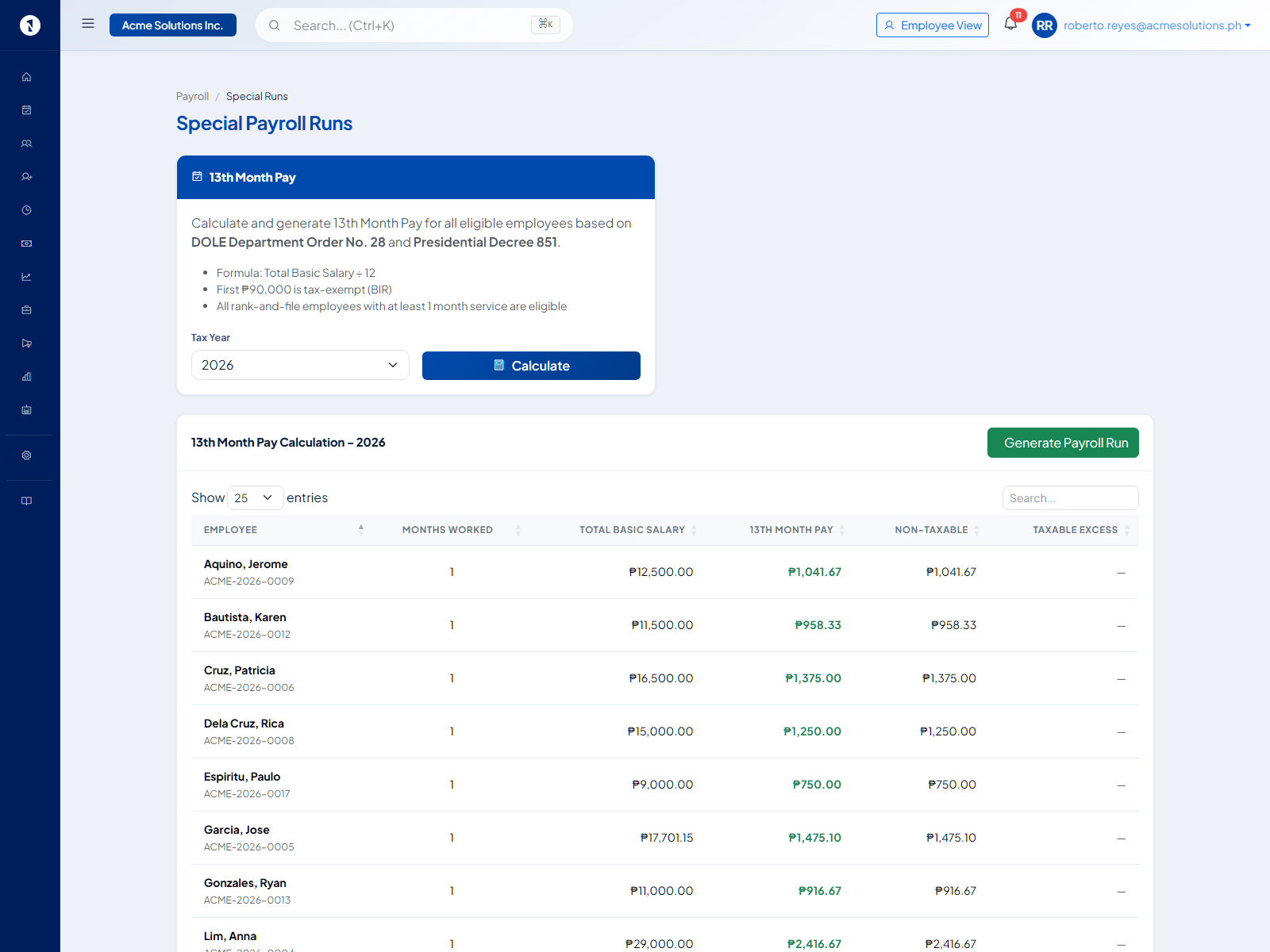
Check the Total Basic Salary column for each employee. If an employee had a salary change or unpaid leave, the individual months should reflect it. See compute 13th month pay for a tax year.
Non-taxable ceiling
The first ₱90,000 of 13th month pay combined with other qualifying benefits is non-taxable. The excess, if any, is added to taxable compensation for the year. See is 13th month pay taxable?.
Questions people ask
Does a salary increase during the year affect 13th month pay?
Yes. 13th month pay is the sum of actual basic salary earned each month, not the current monthly rate times 12. Months before the increase use the old rate and months after use the new rate.
Do unpaid absences reduce 13th month pay?
Yes. 13th month pay is based on basic salary actually earned. Days of unpaid leave reduce the basic salary earned in that month, which reduces the 13th month base.
What is the due date for 13th month pay?
On or before December 24 of each year. Many companies release it in two tranches: half in June or July and the remainder in December.
Is 13th month pay required for all employees?
All rank-and-file employees who have worked at least one month during the calendar year are entitled to it, regardless of employment status (regular, probationary, contractual). Managerial employees are not covered by PD 851 but may receive an equivalent benefit under company policy.
Sources
- Presidential Decree No. 851, 13th month pay
- DOLE Handbook on Workers' Statutory Monetary Benefits, 13th month pay computation